If you’re familiar with SEO (search engine optimization), you know your Google SERP ranking is the holy grail of organic traffic to your site. It’s the difference between a thriving digital storefront and a ghost town 🏜️ Higher rankings generate leads, attract customers, and—the part we actually care about—increase profit. But if you’ve asked yourself, “What is SERP?” one too many times, we’ve got you covered 🤝
Our digital marketing team at Lifted Logic is always down to give clients the “inside scoop.” We’ve been creating custom websites and writing content that ranks on Google for over a decade.
Let’s demystify how Google SERP ranking works.
What is a SERP?
Here’s the quick and dirty: SERP stands for search engine results page.
Imagine typing a question into your favorite search engine—Google, Bing, Yahoo. You search “best marketing firm in Kansas City” and press enter. The page that populates—the one with the links, maps, and AI answers—is the SERP.
SERP Features to Know About
While SERP features have evolved since the early days of the internet, the modern version is the equivalent of a virtual library.
Featured Snippets & AI Overviews
Traditionally, the top of a SERP included a “featured snippet”— a section of text from a reputable website.
In late 2025, Google displaced these snippets with AI overviews. Generated by Gemini, this content gathers information from multiple sources for a more comprehensive answer than traditional snippets. For businesses, appearing in this overview is the new standard for page authority 🏆
What is Domain Authority—and Do I Need it?
Sponsored & Local Links
The first 3 to 6 links on any given SERP are often sponsored or local results, customized for each user.
- Sponsored: Through Google Ads, businesses pay to appear higher on SERPS. If you’re not paying-to-play, you’re likely at the bottom of the page—and let’s be real, most users never scroll that far 😧
- “The Local Pack”: If you search “coffee shop near me” in Kansas City, Google prioritizes pages with matching localized SEO keyphrases over some random spot in NYC.
People Also Ask
This is Google’s crystal ball. 🔮 While it can’t tell you the winning lottery numbers, it analyzes thousands of consumer journeys to predict what users will search for next. That’s how it can suggest following “What is SEO?” with “Why is SEO important?”
Knowledge Panels
These appear on the right side of the screen for well-known people, brands, or places. They display informational snapshots, including:
- People: Full name, birthday, marital status, height, or nationality.
- Brand: Google reviews, website link, trending products, and social media accounts.
- Business: Address, phone number, hours of operation, and Google reviews.

How Google Determines Your SERP Position
In 2026, the Google SERP ranking algorithm has evolved from simple keyword matching to ranking content based on relevance, site speed, and user experience before comparing it to competitors.
How to Better Implement Your Keyphrase | A Guide to Keyphrase Density in Your SEO Content
Why does your position matter? The SERP is the start of the modern consumer journey.
Users rely on search engines to filter “good” content from “bad.” The more authority your website has, the higher you appear on the page, and the more likely users are to visit.
Content Relevance
In the early days of Google Analytics, content relevance tracked only the number of keywords on every page and post on your website. This led to the “keyword stuffing apocalypse” 🧟—where writers excessively inserted these phrases into the text until it wasn’t worth reading anymore.
Forget keyword stuffing—that’s so 2015 👎 Now, Google SERP ranking searches for semantic completeness. To rank well, content should:
- Include new, relevant information and consistently update the site.
- Answer the user’s question and the 3 most-likely follow-up questions.
- Feature sentences that AI can extract for SERP overviews.
How to Think Like a User When Writing Your Website Content
Backlinks
Backlinks are hyperlinks from other sites to yours. While they operate in both directions, having a big name in your industry link to your content is a shot of link juice. Even unlinked mentions of your brand on another site can increase your authority. (⬅️ That’s a backlink.)
User Experience
Let’s try a short exercise: Open your brand’s website in another tab, and pretend you are a brand-new client that’s never seen this page before. Is there a clear, easy-to-use navigation bar? Can you find your team’s contact info?
If your answer was “yes,” you’re on your way to a positive user experience. #winning
Navigation isn’t the only factor in user experience. Everything, from the color of your text to the font you choose, impacts user experience. At Lifted Logic, we emphasize:
- Site speed, or how quickly a page loads. If your page loads slowly, users click off before ever seeing your homepage. Tools like Page Speed Insights can check your website’s loading speed.
- Mobile-Friendliness: Roughly 70% of all Google searches originate from mobile devices. If you haven’t optimized your layout for a phone, you’re practically turning customers away.
How This Connects to AI Overviews
Gemini pulls data from your website using AI. If your site is slow, difficult to navigate, or features outdated content, this program may struggle to read your data, nixing any chances of appearing in the AI overview.
How to Check Your SERP Ranking
In 2026, checking your website’s SERP ranking isn’t a simple search because Google’s algorithm constantly adapts to the latest user data.
When you partner with Lifted Logic, our SEO strategists track your Google SERP position for you. If you’d like to try for yourself, here are our top 3 ways to check your SERP ranking.

Google Search Console
There’s no better way to check your Google SERP ranking than straight from the source. Google Search Console (GSC) uses data directly from the search engine and shows you the average position for keywords that you already rank for.
How to Check:
- Log into your GSC account and select your Property (your website’s domain or URL) from the dropdown menu in the top-left corner.
- In the left-hand menu, click Performance. A line graph will populate, usually preset to show Total clicks and Total impressions.
- Above the graph, click the Average position card. A new orange line will appear on this graph, highlighting your website’s ranking trends over the selected time period.
- Scroll down to the Queries table below the graph. This list shows the keywords users entered into Google’s search bar to find your website, along with the exact Position.
Keep in mind that GSC isn’t a live feed and operates with a 2 to 3-day delay. Also, it only shows your data—not your competitors’—so you can’t spy on their rankings 🕵️
SEMrush
SEMrush is a bird’s-eye view compared to GSC and is best for comparing your website against your competitors’.
How to Check:
- Log into your SEMrush account and click Position Tracking from the left-hand menu under the SEO dashboard.
- Enter your website’s URL and customize your Location and Device for more accurate information.
- Add your keywords to the tracking list. This populates a line graph that highlights your Visibility %, Estimated Traffic, and Average Position for each term.
- Scroll down to the Overview table to track individual keywords. This list shows your current Position and alerts you if you appear in the AI Overview, “Local Pack,” or Featured Snippet.
Want to snoop on your competitors? Enter their website’s URL into Domain Overview and see which keywords they rank for that you don’t.
Manual Search
Sometimes you don’t want to rely on external apps or services, and that’s where manually checking your SERP ranking comes in.
How to Check:
- Open an Incognito or Private browser window.
- Use a VPN (Virtual Private Network) or a tool like I Search From to modify which city or state you want your search to originate from.
- Search for a keyword and count the number of organic links.
- Check the “People Also Ask” boxes or AI overviews to see if Gemini is pulling information from your site—or what it’s prioritizing for that search.
How to Improve Your Google SERP Ranking
If you’re not happy with your Google SERP ranking, don’t despair! Here are our top actionable tips:
1. Meta Tags & Descriptions
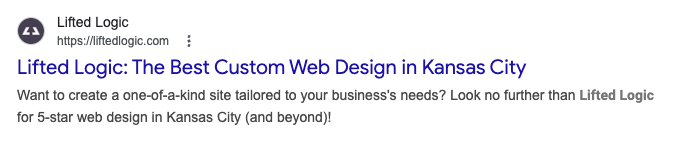
Underneath every hyperlink on the SERP page is a small block of text about 120 to 158 characters long. While Google may generate a description for your webpage if you don’t provide one, writing your own offers a degree of flexibility and customization.
Let’s write our own meta tag for this blog. We need to include the full keyphrase, our company name, and an actionable CTA (call-to-action). Let’s try something like this:
“Master your Google SERP ranking in 2026. Learn how AI overviews work, how to check your position, and tips to improve with Lifted Logic →”
We’ve successfully and naturally incorporated:
- Our keyphrase (Google SERP ranking) ✅
- Our company name (Lifted Logic) ✅
- Created a CTA (learn how…) ✅
- An arrow icon to encourage users to check out our site ✅
2. Content Creation & Updates
While a good meta tag invites users into your digital storefront, quality content encourages them to stay. In 2026, Google measures the value of your text through several standards:
- Information Gain: This is Google’s term for “how unique is your content?” You may have an excellent page about the service you offer, but if users can find all the information on the other top 10 links, it’s not very useful to them.
- First-Hand Experience: Build credibility by incorporating phrases like “I” and “we.” This signals to Google—and the reader—that you’re fully informed about the topic you’re covering. This includes personal statistics, original photos and videos, or a detailed “about us” section.
- Semantics: Include keywords and phrases related to your topic. For this blog, we’ve incorporated mentions of Google Search Console (GSC), keywords, and SEO to inform Google of the context of our content. We’re not talking about vague marketing theories; we are providing a research-based guide for the modern SERP.
- Useful Headings: In today’s digital age, the key characteristic is skimmability. Most users never stop to read your page from top to bottom; instead, they’re looking for headings that tell them what you’re talking about. If people can’t quickly find their answer, (maybe because it’s buried in a mountain of plain text,) they might visit another site.
5 Tips for Improving Your Content Writing
3. Internal Linking & Link Building
We briefly discuss backlinks here, but did we mention the power of linking within your site?
Hyperlinking to reputable sources builds your website’s authority by citing experts, but it also directs users off your site. Conversely, internal linking—directing people to your contact page or a related blog—keeps users engaged and moving through your site.
Say I wanted to convince you to visit our related blog about smart linking tips. By hyperlinking that specific phrase, I’m signaling to Google that the destination page is an authority on that topic. If you’re interested in tried-and-true internal linking methods, you’d click and navigate to a new page on our site.
We recommend linking from high-traffic pages to low-traffic ones. Your homepage is typically the most visible part of your site. Linking to services pages, contact information, or an “about us” page potentially funnels users to lower-ranking pages, continuing the chain.
4. Invest in a Marketing Firm
If your Google SERP ranking is lower than you’d like, but consistently monitoring your position and keeping track of best practices seems overwhelming, relax. There are marketing firms out there—like Lifted Logic 😉—that can handle the website side of your business so you can get back to doing what you love.
At Lifted Logic, our content specialists, strategists, and account managers monitor every move your site makes, and they can offer real-time recommendations to improve where your site stands. You handle the business; we’ll handle the algorithms. You just show up once a month, look at the data, and approve the wins. Bada bing, bada boom—it almost feels like cheating.

Discover A Customized Strategy and Rise Through the Ranks
Stop settling for ‘page ten’ results. When you’re ready to actually move the needle, Lifted Logic is here to build sh*t that performs.
We take the time to get to know your business and find the best way to showcase it through SEO content writing. Whether you choose to have us write your SEO content or elect to write it yourself, your website and Google SERP ranking will benefit from the investment.
Reach out to schedule a free consultation with our team to discuss how an SEO strategy can improve the SERP ranking of your website.
Lifted Logic
Lifted Logic is a team of creative writers, designers, developers, and photographers who specialize in digital storytelling. As a leading web design company in Kansas City, Lifted Logic works with hundreds of small, medium, and large businesses across the country every year.